Inverter vs Non-Inverter Generator: Which to Buy? (November 2026)
Pick an inverter generator when you power electronics or camp near people; a conventional generator wins on price and raw output. In this inverter vs non inverter generator decision, your load type and where the unit runs matter more than wattage alone.
On this page (7 sections)
Pick an inverter generator when you power electronics or camp near people; a conventional generator wins on price and raw output. This inverter vs non inverter generator comparison comes down to load type, noise tolerance and where the unit runs.
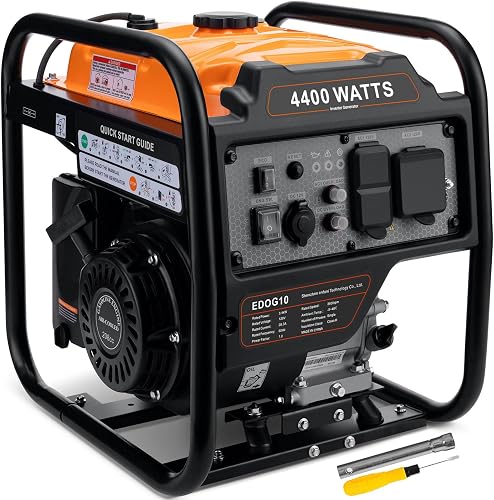
The Oxseryn 4400-Watts Inverter Generator takes the overall win here with clean power, an RV outlet and a 56 lb frame. A conventional generator still makes sense for a job site or a budget build where only power tools run.
 Best for electronics and RV trips
Oxseryn 4400-Watts Inverter Generator
 Best for quiet RV camping
Oxseryn Power Equipment 4400 Watts Inverter Generator
Inverter vs non inverter generator: the quick verdict
For most readers the inverter is the better buy. It protects phones, laptops and TVs, runs quieter at a campsite and uses less fuel at light loads.
The Oxseryn 4400 wins because it covers electronics and RV gear without a huge weight penalty.
A non-inverter generator is the better pick when your load is simple. Power tools, a circular saw or a sump pump don't need clean sine wave power.
You can buy more watts per dollar and skip circuitry you won't use.
The gap is narrower than it sounds on paper. Many modern conventional units run most household tools fine.
The decision turns on whether delicate electronics and neighbors share your power.
When the non-inverter still wins
Choose a conventional generator for a construction site, a farm pump or a backup plan where only motors and lights run. It delivers steady raw AC without the inverter electronics.
That matters when you want the largest wattage for the lowest cost. A conventional unit often gives more running watts per dollar than an inverter at the same price tier.
Skip the inverter premium if you never plug in a TV, laptop or phone charger. You'd pay for clean power you don't need.
How the two designs differ in plain terms
A non-inverter generator runs its engine at a fixed speed and sends that AC straight to the outlets. An inverter generator converts the engine's output to DC, then rebuilds it as a clean sine wave at a steady 60 hertz.
That extra step is the whole story. The electronics in an inverter smooth the power so sensitive devices see stable voltage.
Conventional units can swing in voltage and frequency as the load changes.
The inverter's engine can also slow down when demand is low. That cuts noise and fuel use at light loads.
A conventional engine must keep spinning at a set speed to hold frequency, so it burns more fuel when idle.
What "clean power" really means
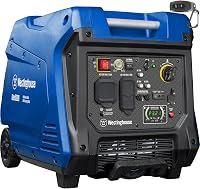
Clean power means low total harmonic distortion. The Westinghouse iGen4500 lists less than 3% THD.
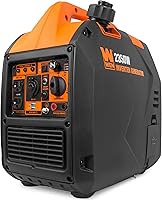
The PowerSmart 4000 lists THD under 3% as well.
Those figures mean the waveform stays close to a smooth sine wave. Electronics such as laptops, TVs and phone chargers tolerate that far better than a jagged supply.
Clean power doesn't mean every appliance works. A large air conditioner or well pump still needs enough running watts, so match the load first and the power quality second.
Engine size and the electronics step
The engine displacement figures hint at how these units are built. The Westinghouse iGen4500 uses a 224 cc four-stroke engine.
The PowerSmart 4000 uses a 149 cc four-stroke.
A smaller engine paired with inverter electronics can still deliver clean 60 hertz power. That is the trade the design makes.
The electronics do the cleaning, not raw engine size.
All three brands here run four-stroke gasoline engines with recoil or electric starting and 60 hertz output. The difference in the inverter vs non inverter generator question is not the engine type.
It is what happens to the current after the engine makes it.
Inverter vs non-inverter generator specs side by side
The table shows how the inverter models here compare on output, weight and noise. A non-inverter unit at the same wattage would typically be lighter and cheaper, but louder and without a THD figure.
| Product | Best for | Peak watts | Running watts | Weight | Our score |
|---|---|---|---|---|---|
| Oxseryn 4400-Watts Inverter Generator | electronics and RV trips | 4400 | 3400 | 56 lb | 9.7 |
| Oxseryn Power Equipment 4400 Watts Inverter Generator | quiet RV camping | 4400 | 3400 | 56 lb | 9.4 |
| Westinghouse iGen4500 5000W Inverter | remote start convenience | 5000 | 3900 | 104.7 lb | 8.9 |
| PowerSmart 4000W Inverter | light electronics backup | 4000 | 3200 | 50.7 lb | 7.7 |
Read the running watts first. Peak watts cover motor startups for a few seconds; running watts carry the load all day.
The Oxseryn units list 3400 running watts against 4400 peak, and that gap matters for an RV air conditioner.
Then check weight. The PowerSmart 4000 is the lightest at 50.7 lb, while the Westinghouse iGen4500 needs its wheel kit at 104.7 lb.
An inverter's electronics add weight, so a lighter unit often means less output.
Output and outlets
The Oxseryn 4400 offers 2 x 120V AC ports, a 30A RV port and a 12V DC port. That mix covers a travel trailer, a few household devices and 12V accessories.
The Westinghouse iGen4500 adds a 5-20R duplex outlet, a TT-30R RV outlet and two USB outlets. USB ports help when you charge phones without an adapter.
The PowerSmart 4000 has a duplex outlet, a 30A twist-lock outlet, a 12V DC port and dual USB ports. Its parallel support lets a second unit double the output later.
Noise and fuel use
Noise separates the two designs clearly. The PowerSmart 4000 lists 59 dBA at 23 ft and the Oxseryn Power Equipment lists under 72 dBA at 23 ft.
A conventional unit at the same output typically runs louder.
Runtime favors the Westinghouse iGen4500 at up to 18 hours on 3.4 gallons. Both Oxseryn units run up to 14 hours at 25% load on a 2 gallon tank.
Fuel tank size, not just design, drives those numbers.
Safety features to expect on either design
Overload protection, low oil shutdown and cold start technology appear on the Oxseryn and PowerSmart units here. Those features protect the engine and the load, and they matter as much as the clean power claim.
The Oxseryn units also list ECO mode. That mode lets the engine idle down when demand is light, which is where an inverter's fuel edge comes from.
The Westinghouse iGen4500 uses the same idea under its Economy Mode name.
An overload shutoff is the feature that keeps a non-inverter's rough output from damaging a device. If the unit trips, remove a load and restart.
Do not keep resetting it with the same load attached.
Which generator suits an RV or campsite?
An inverter generator is the right choice for an RV or campsite. Campgrounds often restrict generator hours and many have noise rules that a loud conventional unit breaks.
The 30A RV outlet on both Oxseryn units powers a travel trailer directly. The Westinghouse iGen4500's TT-30R outlet does the same, and its remote start means you can switch it on without leaving the camper.
Low noise matters more at a campsite than on a driveway. The PowerSmart 4000 at 59 dBA and the Oxseryn Power Equipment under 72 dBA both suit quiet evenings better than a conventional open-frame unit.
Matching an RV air conditioner
RV air conditioners draw a heavy startup surge. Check the running watts first, then leave room for the surge.
The Oxseryn units and the iGen4500 all list around 3400 to 3900 running watts.
If your camper has a 30A inlet, the RV port matters more than the number of household outlets. All three units here include one.
Our Westinghouse inverter generator picks cover more camping-focused models if you want a lighter unit for a small trailer.
Which generator suits home backup?
An inverter generator fits home backup when you need clean power for fridges, routers and medical devices. It runs quiet enough for a neighborhood and keeps electronics safe during an outage.
The Westinghouse iGen4500 suits a longer outage with remote start and up to 18 hours on a full tank. Its 3900 running watts carry a fridge, lights and a router without trouble.
The Oxseryn 4400 units give 3400 running watts and 14 hours at 25% load. That's enough for a fridge, a few lights and phone charging.
Pair a unit with an extension cord plan before the storm arrives.
What to leave off the inverter
Skip the central air conditioner on a portable inverter of this size. A 3400 running watt unit won't carry it, and the surge can trip overload protection.
Keep the load within running watts and add devices one at a time. Overload protection shuts the unit down rather than letting it strain.
That's a feature, not a failure.
If you need to run more, the PowerSmart 4000 supports a parallel kit to double output. Two units cost more than one larger generator, but they split the load and stay portable.
Running a generator safely at home
Place the unit outdoors and away from windows, doors and vents. Exhaust fumes are the main risk with any gasoline generator, inverter or not.
A carbon monoxide alarm inside the home is cheap insurance.
Store gasoline in an approved container and refuel only when the engine is off and cool. The Oxseryn units hold 2 gallons and the Westinghouse iGen4500 holds 3.4 gallons.
A larger tank means fewer refueling trips during a long outage.
Factory testing leaves a slight gas smell on a new unit. Oxseryn notes this on its generators, so it is not a sign of a used generator.
Let the unit air out before first use.
Noise, weight and fuel: the practical differences
Inverters usually run quieter and burn less fuel at light loads, but they cost more and often weigh more. Weigh those trade-offs against how you'll use the unit.
Noise matters when you camp near other people or run a generator in a driveway after dark. The Westinghouse iGen4500 lists as low as 52 dBA on economy mode.
A conventional unit at the same output would be harder to live with.
Weight matters when you load and unload alone. The PowerSmart 4000 at 50.7 lb is the lightest here.
The Westinghouse iGen4500 at 104.7 lb needs its wheel kit and a second pair of hands for a truck bed.
Fuel efficiency at light load
An inverter's engine slows when the load drops. The Oxseryn units run 14 hours at 25% load on a 2 gallon tank.
The Westinghouse iGen4500 runs up to 18 hours on 3.4 gallons.
A conventional generator runs at a fixed speed and burns more fuel when nothing is plugged in. For a long outage where you only power a fridge and a few lights, the inverter saves fuel.
At full load the gap closes. The engine must run near its limit either way, so don't buy an inverter expecting big savings when you run a space heater all night.
Footprint and storage
The dimensions matter when the unit lives in a garage or an RV bay. The Oxseryn 4400 measures 19.4 by 15.2 by 19.2 inches.
The Oxseryn Power Equipment model measures 19 by 15.6 by 19.1 inches.
The PowerSmart 4000 is the smallest at 20.1 by 12.2 by 17.7 inches. The Westinghouse iGen4500 is the largest at 24.5 by 17.5 by 20 inches, and its telescoping handle and wheels add length when extended.
A lighter, smaller unit is easier to store between trips. A bigger tank buys runtime but takes up bay space.
Decide which trade you have room for before buying.
Noise rules and neighbors
Some campgrounds and towns limit generator noise and hours. An inverter's lower noise helps you stay within those rules.
Check local rules before you buy, since a quiet unit can still be banned at certain hours.
The Generac GP3300i inverter review covers another quiet option if you want a smaller camping unit. Compare its noise figure against these models before deciding.
Which should you buy?
Buy an inverter generator for electronics, RV trips and quiet backup; buy a non-inverter generator for raw power on a budget. That's the short answer to the inverter vs non inverter generator question.
Pick the Oxseryn 4400-Watts Inverter Generator for most readers. It balances clean power, an RV outlet and a 56 lb frame at 9.7.
Pick the Oxseryn Power Equipment 4400 for quieter camping with a fuel gauge at 9.4.
Choose the Westinghouse iGen4500 when remote start and long runtime matter more than weight. Pick the PowerSmart 4000 for a light unit with parallel support at a lower output.
Final decision rules
Pick an inverter if you plug in a laptop, TV or phone charger, camp near people or want quiet home backup. Pick a conventional generator if you only run power tools and pumps and want the most watts for the money.
Match running watts to your load first. Then let noise and clean power settle the design.
Our Champion vs Westinghouse generator comparison helps if you're choosing between those two brands.
If you want a smaller camping inverter, the Champion inverter generator lineup is worth a look before you settle on size. For most readers, though, the inverter design is the safer buy.
Frequently asked questions
Is an inverter generator better than a non-inverter generator?
An inverter generator is better for electronics and quiet campsites because it produces clean power with low distortion. A non-inverter generator is the better buy when you only run power tools or a well pump and want the most watts for the money.
Can a non-inverter generator damage a laptop or TV?
It can put sensitive electronics at risk because its power output is less stable. Laptops, TVs and phones are safer on an inverter unit with a low total harmonic distortion figure.
Check the THD rating before plugging in delicate gear.
Why are inverter generators more expensive?
Inverter generators add electronics that convert raw engine output into clean, steady power. That extra circuitry and quieter housing raise the cost.
Non-inverter generators skip it and sell for less at the same wattage.
Do inverter generators use less fuel?
They often do at light loads because the engine can slow down when demand drops. The Oxseryn 4400 runs 14 hours at 25% load on a 2 gallon tank.
Heavy loads narrow the gap, since the engine must run faster.
How long can an inverter generator run on a tank?
Runtime depends on load and tank size. The Oxseryn 4400 runs up to 14 hours at 25% load on 2 gallons.
The Westinghouse iGen4500 runs up to 18 hours on 3.4 gallons.
Bigger loads cut those figures.