9 Best Small Portable Generators (October 2026)
The best small portable generators include the WEN Super Quiet 2350W Inverter for easy storage, the Westinghouse iGen2550 Inverter for small RVs, and the Genmax 2000W Inverter for lighter lifting.
On this page (6 sections)
The WEN Super Quiet 2350W Inverter is the best small portable generator for a light, compact option, with 1,900 rated watts and a 39 lb weight. Choose the Westinghouse iGen2550 for an RV outlet, or the Champion 2500W Dual Fuel if you want gasoline and propane.
Small inverter generators work best when you match their rated output to a short list of essentials. These picks range from 1,000 to 2,250 running or rated watts, so check each appliance's running draw and startup needs before choosing.
For broader household backup, see our portable generator buying guide. If you're planning to power a particular appliance, our 2000 watt generator guide can help set expectations.
Our picks at a glance
-
1

-
2

-
3
- 4
 Check it
Champion 2500W Ultralight Inverter
Best for campsite basics - 5
 Check it
Westinghouse iGen1500c Inverter
Best for low power needs - 6
 Best for extra outputCheck it
- 7
 Best for upkeep trackingCheck it
- 8
 Check it
Champion 2500W Dual Fuel Inverter
Best for propane access - 9
 Best for quiet overnight useCheck it
The best small portable generators by use
The WEN Super Quiet 2350W Inverter and Westinghouse iGen2550 tie for the highest score. The WEN makes sense for a manageable carry weight and general small loads, while the Westinghouse adds a direct RV connection.
How we chose these small portable generators
We compared rated output, weight, fuel choices, outlets and stated safety features against common small-load needs for camping and limited backup. A good fit depends on whether a unit can supply your real load and connect to it safely.
Peak watts describe short startup capacity. Use rated or running watts to plan continuous use, then check whether a motor or compressor needs extra power when it starts.
| Product | Best for | Rated output | Weight | Fuel | Our score |
|---|---|---|---|---|---|
| WEN Super Quiet 2350W Inverter | easy storage | 1,900 watts | 39 lb | Gasoline | 8.2 |
| Westinghouse iGen2550 Inverter | small RVs | 40 lb | Gasoline | 8.2 | |
| Genmax 2000W Inverter | lighter lifting | 34 lb | Gasoline | 8.1 | |
| Champion 2500W Ultralight Inverter | campsite basics | 39.7 lb | Gasoline | 8.0 | |
| Westinghouse iGen1500c Inverter | low power needs | 1,000 watts | 32 lb | Gasoline | 7.9 |
| WEN 2800W Inverter (56280iX) | extra output | 2,250 watts | 45 lb | Gasoline | 7.8 |
| WEN 2500W Inverter (56250i) | upkeep tracking | 1,900 watts | 37.5 lb | Gasoline | 7.6 |
| Champion 2500W Dual Fuel Inverter | propane access | 43.2 lb | Gasoline or propane | 7.5 | |
| PowerSmart 2500W Inverter | quiet overnight use | 1,900 watts | 39.7 lb | Gasoline | 7.3 |
Small portable generator reviews
These small portable generators suit different load sizes, outlet needs and portability priorities. The right choice depends on what you need to power and how often you must move the unit.
WEN Super Quiet 2350W Inverter: Best for easy storage
- 39 lb
- 1,900 rated watts
- Fuel shutoff
- Two USB ports
A 39 lb body and 1,900 rated watts make this a practical compact pick for light loads. It also has fuel shutoff and two USB ports.
Pros
- 39 lb weight
- Fuel shutoff
- Two-year warranty
Cons
- Gasoline only
- No RV TT-30R outlet
The WEN Super Quiet 2350W Inverter is a balanced choice if you want a manageable carry weight without dropping to the lowest output class. It weighs 39 lb and produces 1,900 rated watts, with up to 2,350 surge watts for brief starting demand.
Its panel has two 120V receptacles, one 12V DC receptacle and two USB ports. WEN includes fuel shutoff, which uses remaining carburetor fuel before the engine stops and can help reduce stale fuel buildup during storage.
The 56235i runs on gasoline and has a two-year warranty. Plan around the rated output, since several appliances starting together may exceed available power.
Choose it for a compact general-purpose inverter for electronics, lights and other modest loads. Skip it if you need an RV TT-30R outlet or expect to run several large appliances.
Westinghouse iGen2550 Inverter: Best for small RVs
- 1,900 running watts
- 120V TT-30R 30A outlet
- LED data center
- CO sensor
The TT-30R outlet gives RV owners a direct 30A connection, while the LED data center shows fuel level, output, runtime and voltage.
Pros
- RV TT-30R outlet
- LED data center
- Parallel capable
Cons
- Parallel cables sold separately
- Gasoline only
The Westinghouse iGen2550 Inverter is the clearest RV pick because it has a 120V TT-30R 30A outlet alongside a standard 20A duplex outlet and two USB ports. It produces 1,900 running watts, so the outlet type does not remove the need to check your RV's total load.
The LED data center displays fuel level, power output, remaining runtime and voltage. Westinghouse states up to 11 hours at 25% load and noise as low as 52 dBA.
It weighs 40 lb and includes a CO sensor and overload protection. You can parallel it with a compatible Westinghouse inverter, but the cables are sold separately.
Pick this model for a small RV setup where the TT-30R connection is useful. Skip it if your RV needs more continuous power than the generator can supply, even though the plug fits.
For a fuller load plan, see our 30 amp RV generator guide.
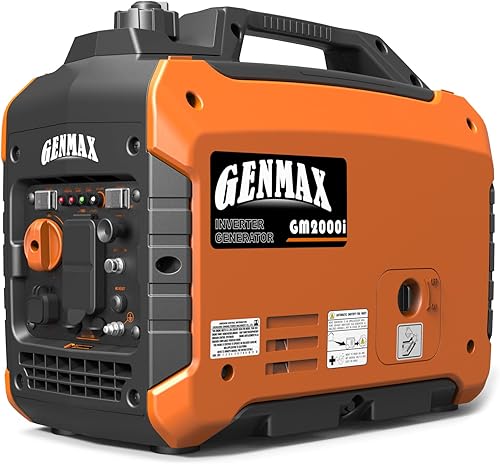
Genmax 2000W Inverter: Best for lighter lifting
- 34 lb
- 1,600 running watts
- CO detect shutdown
- Parallel ready
At 34 lb, this is the lightest pick here. Its 1,600 running watts fit a modest load, and it includes a CO detect shutdown sensor.
Pros
- Lightest pick at 34 lb
- CO detect shutdown
- Parallel ready
Cons
- Lower running output than several picks
- Gasoline only
At 34 lb, the Genmax 2000W Inverter is the lightest generator in this group. Its 1,600 running watts suit a modest load, and it has 120V outlets plus two USB output options.
Genmax states that the 79.7 cc gasoline engine can run for 8 hours at 50% load on a 1 gallon tank. It also includes economy mode, overload and low-oil alarms, and a CO detect shutdown sensor.
The unit is parallel ready, so a compatible second generator can add output. Treat the 2,000 starting watts as a peak figure and plan around its 1,600 running watts.
Choose it when lifting and carrying weight matter most and your load is modest. Skip it if your appliances need more continuous power; the WEN 2800W model later in the roundup has greater rated output.
Champion 2500W Ultralight Inverter: Best for campsite basics
- 1,850 running watts
- 39.7 lb
- CO Shield auto shutoff
- Parallel ready
This compact Champion pairs 1,850 running watts with a household duplex outlet and CO Shield auto shutoff.
Pros
- CO Shield auto shutoff
- Parallel ready
- Three-year limited warranty
Cons
- Gasoline only
- Parallel kit sold separately
The Champion 2500W Ultralight Inverter pairs 1,850 running watts with a 39.7 lb weight and a household duplex outlet. It is suited to camping, tailgating, RV items or a few basic loads, rather than broad home backup.
Champion's CO Shield system automatically shuts the generator off if carbon monoxide reaches a dangerous level. The generator also has a 12V automotive-style outlet and parallel outlets.
Champion states up to 11.5 hours of runtime at 25% load. Its three-year limited warranty includes lifetime technical support, and the parallel kit is sold separately.
Choose it for campsite basics and modest loads. Skip it if propane is important, since this model runs on gasoline; the dual-fuel Champion is the alternative.
Westinghouse iGen1500c Inverter: Best for low power needs
- 1,000 rated watts
- 32 lb
- Two 120V outlets
- Two USB outlets
The 32 lb body is easy to move, and the 1,000 rated watts suit smaller loads such as electronics when your watt needs are modest.
Pros
- 32 lb weight
- Two USB outlets
- Parallel capable
Cons
- Lowest rated output here
- Parallel cord required
The Westinghouse iGen1500c Inverter is a light option at 32 lb, with 1,000 rated watts. That makes it a better fit for charging devices and a few small items than for several household appliances.
The panel has two 120V outlets and two USB outlets. Westinghouse states up to 12 hours of runtime on a 0.79 gallon gasoline tank, and the generator can be paired with another compatible Westinghouse inverter using a separate cord.
It includes a CO sensor and overload protection, plus three-year limited service, labor and parts coverage. Confirm the watt draw of each device before relying on it during an outage.
Pick it for easy moving and light power needs. Skip it if you need to run a refrigerator, pump or multiple appliances without first confirming their running and startup demands.
WEN 2800W Inverter (56280iX): Best for extra output
- 2,250 rated watts
- 45 lb
- CO Watchdog shutdown sensor
- Fuel shutoff
This pick reaches 2,250 rated watts while staying in an inverter format. Its 45 lb weight is higher than the lightest options.
Pros
- Highest rated output here
- CO Watchdog shutdown sensor
- Fuel shutoff
Cons
- Heaviest pick here
- Gasoline only
The WEN 2800W Inverter (56280iX) offers the highest rated output here at 2,250 watts, while its 45 lb weight makes it heavier than the other picks. It produces up to 2,800 surge watts and includes two 120V receptacles, a 12V DC receptacle and two USB ports.
Its Watchdog CO shutdown sensor turns the generator off if it detects dangerous carbon monoxide levels. WEN also includes fuel shutoff, which lets the engine use remaining fuel in the carburetor before stopping.
The 56280iX runs on gasoline and has a three-year warranty. WEN states up to 9 hours at half load, so runtime depends on the connected load.
Choose it when you need more output in a compact inverter format and can manage the extra weight. Skip it if carrying ease matters more than output or if your load exceeds its rated capacity.
WEN 2500W Inverter (56250i): Best for upkeep tracking
- 1,900 rated watts
- 37.5 lb
- Fuel shutoff
- Onboard hour meter
The 37.5 lb body and 1,900 rated watts make this a compact middle ground. Fuel shutoff and an hour meter add useful upkeep features.
Pros
- Fuel shutoff
- Onboard hour meter
- 37.5 lb weight
Cons
- Gasoline only
- No RV TT-30R outlet
The WEN 2500W Inverter (56250i) provides 1,900 rated watts in a 37.5 lb body. An onboard hour meter helps track use, and fuel shutoff uses remaining carburetor fuel before the unit stops.
Its panel includes two 120V receptacles and two USB ports. WEN states that the 80 cc gasoline engine runs up to 4.4 hours at half load on a 1 gallon tank.
This model has a three-year warranty. It does not have an RV TT-30R outlet, so RV buyers should confirm the connection they need before choosing it.
Choose it for a compact mid-range output with upkeep tracking. Skip it if you want long runtime at half load or an RV-specific outlet.
Champion 2500W Dual Fuel Inverter: Best for propane access
- Gasoline or propane
- 1,850 running watts on gas
- CO Shield auto shutoff
- Up to 25 hours on propane
Choose this Champion if you want to switch between gasoline and propane. It weighs 43.2 lb and provides 1,665 running watts on propane.
Pros
- Runs on gasoline or propane
- CO Shield auto shutoff
- Propane runtime up to 25 hours
Cons
- Heavier than the gasoline Champion
- Parallel kit sold separately
The Champion 2500W Dual Fuel Inverter is the only pick here that runs on gasoline or propane. It produces 1,850 running watts on gasoline and 1,665 on propane, so account for the lower output when using propane.
Champion states up to 11.5 hours on gasoline and up to 25 hours on propane. It weighs 43.2 lb and includes a covered household duplex outlet, 12V automotive-style outlet and CO Shield auto shutoff system.
A separately sold parallel kit can connect it with another compatible Champion inverter or power station. The dual-fuel choice adds flexibility, though this unit weighs more than the gasoline-only 2500W Champion.
Pick it if propane access matters and you can plan around its lower output on that fuel. For a closer fuel comparison, read propane vs gas generator guidance.
PowerSmart 2500W Inverter: Best for quiet overnight use
- 1,900 rated watts
- Up to 8 hours at 25% load
- 52 dBA at 25% load from 23 ft
- Two USB ports
PowerSmart states up to 8 hours at 25% load from its 1.06-gallon tank. Its panel includes a household outlet, DC port and two USB ports.
Pros
- Up to 8 hours at 25% load
- Two USB ports
- Parallel ready
Cons
- Gasoline only
- No RV TT-30R outlet
The PowerSmart 2500W Inverter combines 1,900 rated watts with a stated runtime of up to 8 hours at 25% load. It weighs 39.7 lb and its panel has a 120V household outlet, 12V DC port and two USB ports.
PowerSmart states a noise level of 52 dBA at 25% load from 23 ft. Its features also include cold-start technology, low-oil shutdown and parallel readiness.
This generator runs on gasoline and has a two-year limited warranty with lifetime technical support. Use the rated watt figure to avoid overloading it, and follow the manual's operating and care guidance.
Choose it for a longer stated runtime at a light load and a useful mix of ports. Skip it if you need an RV TT-30R connection or propane operation.
How do you choose a small portable generator?
Choose a small portable generator by its running watts, startup needs, weight and outlets. A model that's easy to carry may not have enough continuous output for a refrigerator or pump.
Start with the devices you expect to use at the same time. Note each device's running watts, then account for the largest startup demand among motor-driven appliances.
Our guide to starting watts and running watts explains why those figures differ. If the list includes several household essentials, calculate how many watts you need to run a house before choosing a small model.
Which running watt range fits your load?
A 1,000-watt rated generator fits a smaller load than a 1,900-watt model, while a 2,250-watt unit gives more room for additional devices. Your appliance labels and startup needs determine which range is enough.
A small generator can suit lights, phones and a few electronics, but it may not run multiple household appliances at once. See what a 2000 watt generator can run for examples and load planning.
Don't assume every appliance's watt draw is printed clearly on its casing. Check its manual or manufacturer information, and include devices you might need at the same time, such as lights, chargers and a refrigerator.
Which outlets should you check?
Check the generator's receptacles against the cord or RV connection you plan to use. The Westinghouse iGen2550 has a TT-30R 30A outlet, while most other picks focus on household outlets, USB ports or 12V DC.
An outlet rating does not increase the generator's available running watts. A 30A RV connection can be convenient, but the generator still has a limited total output to share across the connected appliances.
For cord sizing and connections, read our guide to generator extension cords. Match cord ratings and plugs to the generator and load, and keep cords in good condition.
How much should weight matter?
A lower weight helps if you expect to lift the generator into a vehicle or move it between storage and a campsite. The Westinghouse iGen1500c weighs 32 lb, the Genmax weighs 34 lb, and the WEN 2800W model weighs 45 lb.
Consider the whole moving task, not just the listed weight. Think about lifting height, the distance from storage to the operating spot, and whether another person will help.
Measure the space where you'll store the generator and leave room to access it safely. Never plan to run it inside a home, garage, shed or enclosed RV.
Is a CO sensor enough to make generator placement safe?
No. A CO sensor or shutdown feature does not replace safe outdoor placement, and carbon monoxide can build up quickly in enclosed areas.
Run the generator outdoors, far from doors, windows and vents, and follow the manual and CPSC guidance. Read how far a generator should be from the house before setting it up.
Set it on a stable, dry surface in an open outdoor area. Keep the exhaust directed away from people and buildings, and let the unit cool before refueling.
How should you set up and care for a small generator?
Set up a small generator outdoors, check the manual before the first start, and connect only a planned load. Proper placement and basic maintenance matter as much as the model you choose.
Before use, place it on stable ground with space around it and keep it away from openings where exhaust could enter. Check the oil and fuel requirements in the manual, then start it according to the maker's instructions.
Let the generator stabilize before adding appliances, and connect loads one at a time. This makes it easier to notice an overload and keeps you from starting several high-demand devices together.
After use, disconnect appliances and follow the shutdown instructions. If the unit has fuel shutoff, use it as the manual directs; that feature is designed to use remaining carburetor fuel before shutdown.
For storage, follow the manual's guidance for fuel, oil and periodic operation. Keep fuel in approved containers away from living areas, and do not refuel a hot or running generator.
What mistakes should you avoid with a small portable generator?
The most common mistakes are sizing from peak watts, overloading outlets, unsafe placement and choosing a generator before checking the connection. Avoiding these errors makes a small unit more useful and safer to operate.
- Buying from peak watts alone: Peak output is for short startup demand. Use rated or running watts for the sustained load.
- Starting everything at once: A refrigerator, pump or other motor may need extra power at startup. Start appliances one at a time and leave room for that demand.
- Assuming a 30A plug means full RV capacity: The plug fits an RV cord, but the generator's running output still limits what can operate at once.
- Using indoor or enclosed space: Never run a portable generator in a home, garage, shed or enclosed RV. A CO sensor is an added safety feature, not permission to use it indoors.
- Choosing by weight alone: A very light model may be easier to carry but too small for the load. Check output and portability together.
- Ignoring fuel and storage needs: Gasoline-only models require gasoline planning. If propane is part of your plan, choose a dual-fuel model and account for its fuel-specific output.
Which small portable generator should you choose?
Choose the WEN Super Quiet 2350W Inverter for a compact general-purpose pick, the Westinghouse iGen2550 for an RV TT-30R connection, or the Champion 2500W Dual Fuel for gasoline and propane flexibility. If minimum carrying weight matters most, compare the Genmax and Westinghouse iGen1500c.
Use the generator's rated watts and the devices' startup needs as your final check. For a broader range of sizes and uses, see our best portable generators guide.
Our top 3 picks at a glance
-
1
-
2
-
3
Frequently asked questions
What is the best small portable generator?
The WEN Super Quiet 2350W Inverter is a strong fit if you want 1,900 rated watts in a 39 lb package. For an RV connection, consider the Westinghouse iGen2550, which has a TT-30R 30A outlet.
Choose by running watts and outlet needs, not the peak watt number alone.
Can a small portable generator run a refrigerator?
It may, if the generator can handle the refrigerator's running watts and its startup demand. Check the appliance label or manual, then compare starting and running watts with the generator's rated output.
Our guide to choosing a generator for a refrigerator explains the sizing steps.
How many watts does a small portable generator have?
Small inverter generators vary by model. The picks here range from 1,000 to 2,250 rated or running watts, with higher peak output on some models.
Use rated or running watts when adding the devices you plan to power, and leave room for startup loads.
Can a small generator power a 30 amp RV?
A generator with a TT-30R outlet provides a 30A connection, but that does not mean it can run every RV appliance at once. The Westinghouse iGen2550 has that outlet and 1,900 running watts.
See our 30 amp RV generator sizing guide for load planning.
Can you use a small portable generator indoors?
No. Run a portable generator outdoors, well away from doors, windows and vents, and follow the manufacturer's manual and CPSC guidance.
Read our guide on how far a generator should be from the house before setting it up.