Champion vs Predator Inverter Generators: Which to Buy? (November 2026)
Pick a Champion inverter generator for most homes and RVs, because the Champion 4000W Dual Fuel RV Inverter offers propane or gasoline and a 30A RV outlet. Predator inverters make sense when you need more starting watts for a big air conditioner.
On this page (8 sections)
- Champion vs Predator: which one wins for most buyers?
- How do Champion and Predator inverters compare side by side?
- Which brand offers better fuel flexibility?
- Which is quieter at the campsite?
- Which one handles RV and home loads better?
- Which brand is easier to live with?
- Who should buy which?
- Champion vs Predator inverter generators: the verdict
Pick a Champion inverter generator for most homes and RVs, because the Champion 4000W Dual Fuel RV Inverter runs on propane or gasoline and includes a 30A RV outlet. Predator inverters make sense when you need more starting watts for a big air conditioner or you want the most output for the money.
This Champion vs Predator inverter generators comparison looks at what actually changes the decision: usable watts, fuel choice, noise and RV outlets. Predator sells through Harbor Freight and keeps its specs simple.
Champion sells a wider dual-fuel range with RV-ready outlets and CO shutoff.

Champion vs Predator: which one wins for most buyers?
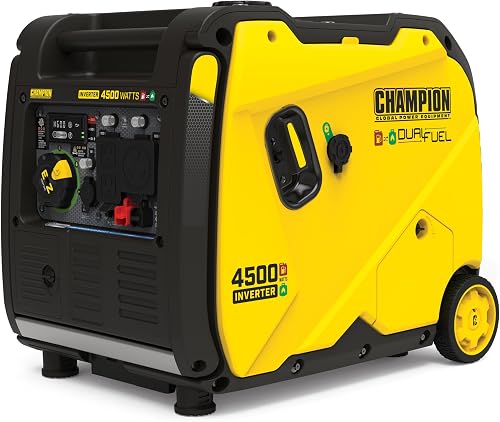
Champion wins for most buyers, because its dual-fuel inverters fit both campsites and light home backup without a second fuel setup. The Champion 4000W Dual Fuel RV Inverter scores 8.8 here against 8.5 for the larger Champion 4500W model, and both sit ahead of a typical Predator inverter on fuel flexibility.
Predator's strength is raw watts per size. Its inverter line leans toward larger running outputs for the money, which helps when a single big load decides the purchase.
The trade-off is fewer dual-fuel options and less focus on RV outlets.
That trade-off shows up in the fine print. A gasoline-only unit means you carry gas cans and deal with fuel that can go stale between trips.
A dual-fuel Champion lets you run from a 20-pound propane tank you already own for a grill or patio heater.
So the honest split is this: Champion for fuel choice, noise and RV wiring; Predator for higher output at a given size. If you're weighing a broader Champion lineup first, our guide to the champion inverter generator picks covers the main sizes.
How do Champion and Predator inverters compare side by side?
The two Champion models here show the range you're choosing from, and Predator sits close on power but behind on fuel options. Use the table to see where each one lands.
| Product | Best for | Fuel | Running watts | Weight | Our score |
|---|---|---|---|---|---|
| Champion 4000W Dual Fuel RV Inverter | RV owners | Gasoline or propane | 3000 gas / 2700 propane | 51.8 lb | 8.8 |
| Champion 4500W Dual Fuel Inverter | bigger loads | Gasoline or propane | 3500 gas / 3150 propane | 99.2 lb | 8.5 |
The 4000W model starts at 4000 watts and runs at 3000 on gasoline or 2700 on propane. The 4500W model starts at 4500 and runs at 3500 on gasoline or 3150 on propane.
Both include CO Shield auto shutoff and both are parallel ready with an optional kit.
Predator inverters typically publish similar running-watt tiers, but the fuel story is narrower. Many Predator units are gasoline only, so you'd add a propane conversion or accept gasoline storage.
What the specs tell you about each brand
Champion publishes clean power under 3% THD on these models. That number matters if you'll plug in a laptop, TV or RV electronics.
Both Champions also carry CO Shield, which shuts the unit down when carbon monoxide builds up.
The 4000W model weighs 51.8 lb and measures 17.9 x 11.7 x 19.7 inches. The 4500W model weighs 99.2 lb and measures 23.2 x 17.7 x 20.1 inches.
That weight and size gap changes who can move it alone and how much truck bed or storage space it takes.
The engines differ too. The 4000W model uses a 149cc engine with a 1.54-gallon tank.
The 4500W model uses a 212cc engine with a 2.3-gallon tank. The bigger engine is what buys the extra watts, and the bigger tank is what stretches the gasoline run time.
Predator inverters often land between those weights for similar output. The deciding factor is usually the outlet panel and fuel type, not the engine size.
A 149cc engine and a 212cc engine can both make inverter power; what you plug into them is what you live with.
Which brand offers better fuel flexibility?
Champion wins on fuel flexibility, because both models here run on gasoline or propane out of the box. Predator inverters are mostly gasoline only, which is the biggest practical gap in this Champion vs Predator inverter generators matchup.
Propane matters for two reasons. It stores longer without going stale, and it lets you run from a 20-pound tank instead of refilling a small gas tank.
The 4000W Champion runs up to 25 hours on propane at 25% load, compared with 10 hours on gasoline.
The 4500W Champion runs up to 21 hours on propane and up to 14 hours on gasoline at the same load. Its 2.3-gallon tank is larger than the 1.54-gallon tank on the 4000W model.
Both switch fuels with the EZ Start Dial, so you don't need tools to change over.
What dual fuel costs you in watts
Propane is not free power. On the 4000W model, running watts drop from 3000 on gasoline to 2700 on propane.
On the 4500W model, they drop from 3500 to 3150. Starting watts stay at 4000 and 4500 respectively.
Plan your loads around the fuel you'll actually use. If you need every running watt for an air conditioner, gasoline is the stronger fuel.
If you want long, quiet overnight runs and fuel that keeps, propane wins despite the lower number.
Predator buyers who only use gasoline won't miss this. But if you want a fuel you can keep for an outage season, the dual-fuel Champions are the easier call.
Which is quieter at the campsite?
Champion's inverter models are quiet for their class, and the 4500W model is the quieter of the two at 61 dBA from 23 feet. Predator inverter generators are also built to be quiet, but published dBA figures vary by model and load.
The 4000W Champion runs at 64 dBA from 23 feet. That's about the level of a normal conversation at that distance.
The 4500W model is a little quieter at 61 dBA, which is closer to quiet speech.
Both use inverter technology, so the engine speed follows the load instead of running flat out. That keeps noise lower when you're charging a phone or running a few lights.
It gets louder when an air conditioner kicks on.
The CO Shield system on both Champions is part of the same package. It monitors carbon monoxide and shuts the generator down before levels get dangerous.
That matters more at a campsite, where the unit may sit close to a tent or RV window.
Predator's inverter units follow the same quiet-engine principle. The difference is smaller than the gap between an inverter and an open-frame generator, so don't choose between these brands on noise alone.
Noise and campground rules
Many campgrounds set quiet-hour limits and some cap generator noise. Check the rule at your site before you book.
A 61 to 64 dBA unit is easier to keep within those limits than a louder open-frame model.
Place the generator away from your RV door and tent. Point the exhaust away from shared space.
Champion includes CO Shield auto shutoff on both models, which is a safety feature worth knowing about.
Which one handles RV and home loads better?
Champion wins for RV use, because the 4000W Dual Fuel RV Inverter includes a 120V 25A TT-30R outlet and clean power under 3% THD. Predator inverters can run an RV, but you'll check the outlet panel more carefully.
The TT-30R outlet is the standard 30A RV connection. That lets you plug a travel trailer or motorhome shore cord straight into the generator without an adapter.
The 4000W model also has a 120V 20A household duplex outlet and a 12V automotive-style outlet.
The 4500W Champion has a 120V 30A RV outlet plus a 120V 20A duplex and a 12V regulated outlet. It gives you 3500 running watts on gasoline, enough for a small air conditioner plus a few basics.
For home backup, both Champions cover a fridge, lights, router and phone chargers. A 3000 to 3500 running-watt unit won't run a whole house, so plan your circuits.
Add up the running watts of what you need at once and leave room for the startup surge of a fridge or furnace motor.
Can you parallel two units?
Both Champions are parallel ready with an optional kit sold separately. You can pair two to raise output or run longer.
That's useful if you start with one and add a second later.
The 4000W model's parallel kit adds a standard 30A RV outlet and a 120V 30A locking outlet. The 4500W model's kit includes a standard 50-amp RV outlet.
Check which kit matches your unit before you buy two.
Predator also sells parallel-capable models. Check the kit compatibility before you buy two different units.
Parallel kits are brand and model specific.
Which brand is easier to live with?
Champion is easier to live with for most people, because dual fuel and RV outlets remove adapters and extra fuel cans from the routine. Predator is easier on the wallet per watt, but that advantage narrows when you add a propane conversion.
The 4000W Champion weighs 51.8 lb and has a recoil start with an EZ Start Dial and Cold Start Technology. One person can lift it into a truck bed.
Cold Start Technology helps it fire quickly in cold weather, which matters for fall camping and winter outages.
The 4500W Champion weighs 99.2 lb and adds electric start plus an Intelligauge power meter that shows voltage, frequency and run hours. It also has a fuel gauge and never flat tires with a fold-down handle.
Plan on two people or a ramp for that one.
Both carry a 3-year limited warranty with free lifetime technical support. Champion also includes CO Shield auto shutoff on both models.
Maintenance and daily use
Maintenance is similar on either brand: oil changes, spark plug checks and air filter cleaning. The 4500W model has a no-tool access panel and an oil drain tube, which makes routine oil changes simpler.
It takes 10W-30 oil, and oil is included in the box.
The 4500W model has a 0.5-quart oil capacity and a low oil shutoff sensor, so the engine protects itself if the oil runs low. It also comes with a wrench, spark plug wrench and screwdriver for basic service.
Fuel storage is the everyday difference. Gasoline needs to be used or stabilized, while a propane tank can sit for months.
If the generator lives in a garage between trips, that is a real point for Champion's dual-fuel design.
Who should buy which?
Buy Champion for RV trips and dual-fuel backup; buy Predator for maximum output on a gasoline budget. The decision usually comes down to whether propane matters to you.
Buy the Champion 4000W if you camp or tailgate with an RV
This is the best pick for most readers. It's light enough to move alone, runs on propane or gasoline and plugs straight into a 30A RV cord.
It's also the lighter of the two options on paper at 51.8 lb.
If you want to read more about this exact unit, our champion 4000 watt generator review covers its outlets and run times in detail.
Buy the Champion 4500W if you need more watts and electric start
Step up to this one when a bigger air conditioner or more appliances are part of the plan. The electric start and power meter are nice for anyone who runs the generator often.
The 99.2 lb weight is the price you pay.
Buy a Predator if gasoline only works for you and watts per dollar matter
Predator suits a buyer who wants the most running watts for the money and won't use propane. Check the outlet panel for a 30A RV outlet if you plan to camp.
If you're also weighing another budget brand, our champion generator vs westinghouse generator comparison covers that matchup.
Champion vs Predator inverter generators: the verdict
Choose Champion for most homes and RVs, because the Champion 4000W Dual Fuel RV Inverter balances weight, noise and dual-fuel RV-ready power. It's the highest-scoring unit here at 8.8 and the one we'd buy first for camping, tailgating or light backup.
Step up to the Champion 4500W model when you need 3500 running watts and electric start. Its 8.5 score reflects the extra power against the extra weight.
At 99.2 lb it is a two-person lift, so be honest about how often you'll move it.
Pick a Predator inverter only if gasoline is fine and you want the most watts per size. Compare the outlets and published dBA first.
For another head-to-head in the same class, see our champion vs generac generator comparison before you settle on a brand.
Frequently asked questions
Is Champion better than Predator for inverter generators?
Champion wins for most buyers because its dual-fuel models run on propane or gasoline and many include a 30A RV outlet. Predator's edge is higher output for the money in some sizes.
Compare the exact model's running watts and outlets before you decide.
Can a Champion inverter generator run an RV air conditioner?
The Champion 4000W Dual Fuel RV Inverter gives 4000 starting watts and 3000 running watts on gasoline. That covers many small to mid-size RV air conditioners when nothing else runs at the same time.
Check your air conditioner's startup draw before you buy.
How loud is a Champion inverter generator compared with a Predator?
Champion publishes 64 dBA at 23 feet for the 4000W Dual Fuel and 61 dBA for the 4500W model. Compare Predator's published dBA at the same distance and load.
Inverter models are quieter than open-frame generators, but both get louder as the load grows.
Is dual fuel worth it on a generator?
Dual fuel is worth it if you want a longer run on propane or a fuel you can store longer without gumming up the carburetor. Propane usually gives less running wattage than gasoline on the same unit, so plan your loads around the fuel you'll use.
What size inverter generator do I need for home backup?
Add the running watts of the appliances you need at the same time, then allow for the startup surge of motors like a fridge or furnace. A 3000 to 3500 running-watt inverter covers a few basics.
Whole-home backup needs a larger unit or a transfer switch.