Champion vs WEN Generators: Which to Buy? (November 2026)
Champion wins for most buyers who want dual fuel and inverter power in one unit, while WEN wins on light weight and simple gasoline value. The champion vs wen generators choice comes down to whether you need propane backup or just clean, quiet power for small loads.
On this page (9 sections)
- Champion vs WEN generators: which brand fits you?
- Champion vs WEN generators side by side
- Which fuel setup suits your routine?
- How much clean, quiet power do you need?
- Which generator is easier to move and store?
- When is a conventional generator the right call?
- How do Champion and WEN compare on outlets and RV use?
- Champion vs WEN generators: who should buy which?
- The verdict
Champion wins for most buyers who want dual fuel and inverter power in one unit, while WEN wins on light weight and simple gasoline value. The champion vs wen generators decision comes down to whether you need propane backup or just clean, quiet power for small loads.
Both brands build reliable machines at fair prices. The gap is in what each one is designed to do: Champion leans toward dual fuel inverter models for RVs and camping, and WEN splits its lineup between tiny gasoline inverters and bigger conventional backup generators.
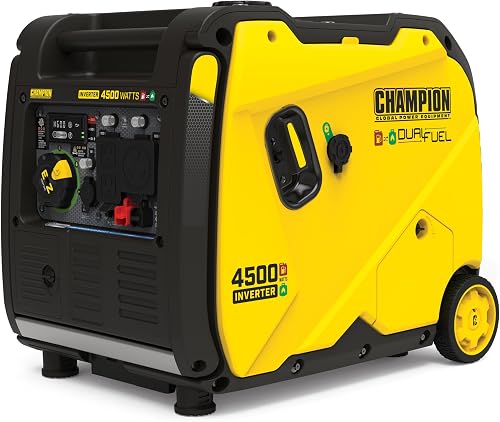
This comparison lines up four models head to head. Two are Champion dual fuel inverters; one is a WEN ultralight inverter and the other a WEN dual fuel conventional generator.
We checked the specs and features to show where each brand earns its place.

Champion vs WEN generators: which brand fits you?
Choose Champion if you want a dual fuel inverter that stays quiet and light. Choose WEN if you want the lightest camping generator or a 240V home-backup unit for less.
The brand name matters less than the model type you land on.
Champion's two units here are both inverters. They produce clean power for electronics and run on gasoline or propane.
WEN's 2350W is also an inverter, but gasoline only and very small. The WEN 4750W is a conventional generator with 240V output for a transfer switch.
That split is the real story. Champion's strength is the dual fuel inverter combo.
WEN's strength is covering both ends of the size range, from a 39 lb camping unit to a wheeled home-backup machine.
If you want one generator to do camping and light backup, a Champion inverter is the safer bet. If your needs are clear at one end of the scale, WEN has a model that fits.
Champion vs WEN generators side by side
The table below shows the four models by wattage, fuel, weight and sound. It's the quickest way to see which unit matches your loads and how you'll move it.
| Product | Best for | Output | Weight | Fuel | Our score |
|---|---|---|---|---|---|
| Champion 4000W Dual Fuel RV Inverter | RV and tailgating | 4000W start / 3000W run (gas) | 51.8 lb | Gasoline or propane | 8.8 |
| Champion 4500W Dual Fuel Inverter | longer runtime | 4500W start / 3500W run (gas) | 99.2 lb | Gasoline or propane | 8.5 |
| WEN Super Quiet 2350W Inverter | light camping | 2350W surge / 1900W rated | 39 lb | Gasoline only | 8.2 |
| WEN 4750W Dual Fuel (DF475T) | home backup | 4750W surge / 3800W run (gas) | 105.8 lb | Gasoline or propane | 8.2 |
The two Champion inverters give you dual fuel and clean power in a portable body. The WEN 2350W is the lightest and quietest, but it's gasoline only.
The WEN 4750W is the biggest and the only one with 240V output.
Weight tracks size closely. The 2350W WEN is 39 lb, the 4000W Champion is 51.8 lb, and the 4500W Champion and 4750W WEN are near or over 100 lb.
Plan how you'll load and move each one before you buy.
Where the engine sizes land
Engine size follows the same pattern as weight. The WEN 2350W uses a 79cc 4-stroke OHV engine, the Champion 4000W a 149cc 4-stroke, the Champion 4500W a 212cc 4-stroke and the WEN DF475T a 224cc 4-stroke OHV.
A larger engine does more than add watts. It also carries a bigger fuel tank and longer run times.
The 2350W WEN holds one gallon, the Champion 4000W holds 1.54 gallons, the Champion 4500W holds 2.3 gallons and the WEN DF475T holds 4 gallons.
That matters when you plan a trip or an outage. A bigger tank means fewer refuels, but it also means more weight to move and more fuel to store.
Match engine and tank size to how long you actually run the unit, not to the biggest number on the page.
Which fuel setup suits your routine?
Dual fuel is the biggest reason to pick Champion. Propane keeps a generator running when gasoline is hard to store or ration during an outage.
WEN gives you dual fuel only on the bigger DF475T.
The Champion 4000W runs 3000 watts on gasoline and 2700 watts on propane. Its propane tank lasts up to 25 hours at 25% load, against 10 hours on a full gasoline tank.
That long propane run time is useful in a multi-day outage.
The Champion 4500W follows the same pattern. It makes 3500 running watts on gasoline and 3150 on propane, with up to 21 hours on a 20 lb propane tank.
The electric start and EZ Start Dial make switching fuels simple.
The WEN 2350W is gasoline only. That's fine for short camping trips, but it means storing and rotating fuel.
The WEN 4750W DF475T runs on both fuels with a selection dial. It makes 3800 running watts on gasoline and 3500 on propane, and it includes a 47-inch LPG hose.
Propane matters most when a storm knocks out the gas station. If you want that backup without giving up inverter power, the Champion pair is the natural choice.
If propane is only for occasional home backup, the WEN DF475T handles it.
How much clean, quiet power do you need?
Champion inverters give clean power with CO Shield safety, while WEN's small inverter is quieter and lighter but much smaller. Match running watts to your real loads before choosing.
Both Champion models produce clean power under 3% THD, safe for laptops and TVs. The 4000W model adds a CO Shield auto shutoff system that stops the unit if carbon monoxide builds up.
The 4500W carries the same CO Shield feature.
The 4000W Champion runs at 64 dBA from 23 feet. The 4500W is quieter at 61 dBA.
The WEN 2350W runs at 51 dB at quarter load, which the brand compares to a normal conversation. It's the quietest of the four.
Running watts set what you can power. The 2350W WEN gives 1900 rated watts, enough for a fridge, lights and phone chargers but not an RV air conditioner.
The Champion 4000W gives 3000 watts, and the 4500W gives 3500. Those higher figures open up RV air conditioners and more appliances at once.
If sound and weight matter more than capacity, the WEN 2350W wins. If you need to run real household or RV loads quietly, a Champion inverter fits better.
Our Champion inverter generator picks cover more models in the same family.
Which generator is easier to move and store?
WEN wins the portability contest with its 39 lb inverter. Champion stays manageable at 51.8 lb on the 4000W model but gets heavy at 99.2 lb on the 4500W.
The WEN DF475T adds a wheel kit for its 105.8 lb body.
The 2350W WEN measures 17.3 x 11.5 x 17.5 inches and weighs 39 lb. One person can lift it into a truck bed or carry it to a campsite.
The Champion 4000W is 51.8 lb and measures 17.9 x 11.7 x 19.7 inches, light enough to move with two hands but not a one-hand carry.
The Champion 4500W jumps to 99.2 lb. That's a two-person lift or a cart job.
The WEN DF475T is 105.8 lb, but it ships with a wheel kit and fold-down handle, so you roll it rather than carry it.
For a tent camper or a small trailer, the WEN 2350W is the easy pick. For an RV owner who wants dual fuel and inverter power, the Champion 4000W balances weight and capability.
For a home setup where the unit stays put, the heavier models are fine.
When is a conventional generator the right call?
Pick the WEN DF475T when you need 240V output for a transfer switch or a 30A twist lock outlet. Inverters like the Champions suit electronics, but a conventional generator gives you the higher voltage a home panel needs.
The DF475T switches between 120V and 240V. Its NEMA 30A twist lock (L14-30R) outlet connects to a transfer switch.
That makes it a practical home-backup choice, and its 224cc engine and electric start keep startup simple.
The trade-off is sound and weight. It's a conventional generator, so it runs louder than the inverter models.
At 105.8 lb it needs the wheel kit, and its 4-gallon tank gives up to 11 hours at half load.
If your main goal is powering a home panel during outages, the WEN DF475T is the better fit of the four. If you mostly camp or tailgate and want clean, quiet power, the Champion inverters are the better match.
Our DuroMax vs DuroStar comparison covers another dual fuel pair if you're still weighing brands.
How do Champion and WEN compare on outlets and RV use?
The Champion 4000W is the most RV-ready unit here, with a TT-30R outlet and parallel support. The WEN 2350W is better for tents and small devices.
Outlet type decides which one plugs into your setup.
The Champion 4000W includes a 120V 25A TT-30R outlet for an RV, a household duplex outlet and a 12V automotive-style outlet. It's also parallel ready, so an optional kit lets you pair it with another Champion inverter for more power.
The Champion 4500W offers similar RV-ready outlets plus a covered panel. Its parallel kit is also sold separately.
Both Champions carry a 3-year limited warranty.
The WEN 2350W has two 120V household outlets, a 12V DC outlet and two USB ports. It's aimed at phones, tablets and small appliances rather than an RV hookup.
The WEN DF475T adds GFCI household outlets and the 30A twist lock for transfer switches.
If you tow an RV, the Champion 4000W is the simplest plug-and-play choice. If you camp in a tent or a van without air conditioning, the WEN 2350W covers the basics.
Our Champion vs Westinghouse comparison shows how another brand handles the same RV outlets.
What the parallel kits add
Both Champion units are Parallel Ready. The optional kit, sold separately, connects the inverter to another Parallel Ready Champion Inverter or Power Station.
That gives you more power and longer run time without buying a bigger single unit.
The kit includes a standard 30A RV outlet and a 120V 30A locking outlet. Two 4000W Champions paired this way give you more usable capacity for a large RV or a longer outage.
The WEN 2350W has no parallel outlets, so it can't grow the same way.
If you expect your needs to rise over time, parallel support matters. Start with one Champion inverter and add a second when your loads grow.
That path keeps each piece portable, unlike a single heavy 99.2 lb or 105.8 lb unit.
Champion vs WEN generators: who should buy which?
Buy Champion for a dual fuel inverter that handles RV loads quietly. Buy WEN for an ultralight camping generator or a 240V home-backup unit.
Pick by your loads first, then by weight and fuel.
Choose the Champion 4000W if you want one generator for RV trips and light backup. It runs 3000 watts on gasoline and 2700 on propane, weighs 51.8 lb, and includes CO Shield and a TT-30R outlet.
It's the best overall pick in this matchup.
Choose the Champion 4500W if you need more running watts and longer runtime. Its 3500 running watts on gasoline and 61 dBA sound level suit a larger RV or a few home essentials.
The electric start helps when it's cold or wet.
Choose the WEN 2350W if you camp light and want the quietest, easiest generator to carry. Its 39 lb body and 51 dB rating make it simple to move and easy on the ears.
Just keep your loads under 1900 watts.
Choose the WEN DF475T if your goal is home backup with a transfer switch. Its 120V/240V output and 30A twist lock outlet connect to a home panel, and dual fuel adds flexibility.
The wheel kit makes its weight manageable.
For a broader look at Champion against another major brand, our Champion vs Generac portable comparison covers the same buying questions. And if you only need camping power, start with a small Champion inverter and skip the bigger units.
The verdict
For most readers, the Champion 4000W dual fuel inverter is the best buy in the Champion vs WEN matchup. It combines propane backup, clean inverter power, CO Shield and a 51.8 lb body at a price tier that suits RV owners and campers.
The WEN 2350W is the right pick when light weight and low noise matter more than capacity. It's the easiest generator here to carry and the quietest on paper.
The WEN DF475T is the home-backup specialist, with 240V output and a transfer-switch-ready outlet.
Pick the Champion 4000W for RV and tailgating use. Pick the Champion 4500W for more watts and longer runtime.
Pick the WEN 2350W for tent camping. Pick the WEN DF475T for a home panel.
That's the whole champion vs wen generators decision in one line.
Frequently asked questions
Can a WEN generator run an RV air conditioner?
The WEN 2350W cannot start most RV air conditioners on its 1900 rated watts. The WEN 4750W dual fuel model has enough surge for some smaller units, but check your air conditioner's starting watts first.
Do Champion generators run on propane?
The two Champion models compared here both run on gasoline or propane. Propane lowers running watts slightly, so plan loads around the propane figure if you want fuel flexibility.
Which generator is quieter, Champion or WEN?
The WEN 2350W is rated at 51 dB at quarter load. The Champion 4000W is rated at 64 dBA at 23 feet and the 4500W at 61 dBA.
Lower numbers mean quieter, so the small WEN wins on sound.
How much generator do I need for home backup?
Add the running watts of the appliances you need at once, then allow for startup surge on motors. The Champion 4500W and WEN 4750W both give around 3500 running watts on gasoline, enough for a fridge, lights and a few small devices.


