10 Best Portable Generators for a House (October 2026)
The best portable generators for house backup include the Westinghouse 12500W Dual Fuel Home Backup for larger backup loads, the Westinghouse 6500W Dual Fuel Home Backup for essential household circuits, and the WEN 6800W Dual Fuel RV Inverter (DF680iX) for inverter power with 240V.
On this page (10 sections)
- How these portable generators for a house compare
- The best portable generators for house backup
- How to choose a portable generator for a house
- Which generator size suits your backup plan?
- Should you choose gasoline, propane or natural gas?
- Does a 30A or 50A outlet matter for home backup?
- How should you set up and care for a home generator?
- What mistakes should you avoid with a portable generator for house backup?
- Where should a portable generator sit during an outage?
- Which portable generator for a house should you choose?
The best portable generator for a house depends on the loads you want to power and the connection your home needs. The Westinghouse 12500W Dual Fuel Home Backup leads this group for higher planned loads, while smaller models can suit essential circuits or a limited outage plan.
Start by listing the appliances you want to run together. Add their running watts, then account for the largest starting demand from a motor, pump or compressor.
For a load-by-load starting point, see how many watts you need to run a house. Our portable generators for home use guide covers other features that affect backup choices.
Our picks at a glance
-
1
 Best for larger backup loads
Westinghouse 12500W Dual Fuel Home Backup
9.0/10 our score
See it on Amazon -
2
 Best for essential household circuits
Westinghouse 6500W Dual Fuel Home Backup
8.5/10 our score
See it on Amazon -
3
 Best for inverter power with 240V
WEN 6800W Dual Fuel RV Inverter (DF680iX)
8.5/10 our score
See it on Amazon
- 4
 Check it
Westinghouse 9500W Dual Fuel Home Backup
Best for remote electric start - 5
 Check it
Westinghouse 8200W Tri-Fuel Inverter
Best for three fuel choices - 6
 Best for CO-monitored backupCheck it
- 7
 Check it
DuroMax XP5500HX 5500W Dual Fuel
Best for lower-output plans - 8
 Check it
Westinghouse 6600W Gas Home Backup
Best for gasoline-only backup - 9
 Check it
DuroMax XP5500EH 5500W Dual Fuel
Best for basic dual-fuel flexibility - 10
 Check it
Genmax 8000W Tri-Fuel Inverter
Best for remote fuel flexibility
How these portable generators for a house compare
The models below are ordered by score, with the highest-rated picks first. Their running output, fuel options, home-ready outlets and outage-use features help distinguish one plan from another.
The useful comparison is the running wattage for your chosen fuel, along with the starting capacity and outlet your home setup requires. A generator's wattage alone does not show whether it can power every circuit in a house.
| Product | Best for | Running watts (gasoline) | Fuel | Home outlet | Our score |
|---|---|---|---|---|---|
| Westinghouse 12500W Dual Fuel Home Backup | larger backup loads | 9500 W | Gasoline or propane | 120/240V 14–50R 50A | 9.0 |
| Westinghouse 6500W Dual Fuel Home Backup | essential household circuits | 5300 W | Gasoline or propane | 120/240V L14-30R 30A | 8.5 |
| WEN 6800W Dual Fuel RV Inverter (DF680iX) | inverter power with 240V | Gasoline or propane | 120/240V L14-30R | 8.5 | |
| Westinghouse 9500W Dual Fuel Home Backup | remote electric start | 7500 W | Gasoline or propane | 120/240V L14-30R 30A | 8.3 |
| Westinghouse 8200W Tri-Fuel Inverter | three fuel choices | 6600 W | Gasoline, propane or natural gas | 120/240V 14–50R 50A | 8.1 |
| WEN 8000W Dual Fuel | CO-monitored backup | Gasoline or propane | 120/240V L14-30R 30A | 8.0 | |
| DuroMax XP5500HX 5500W Dual Fuel | lower-output plans | Gasoline or propane | 120/240V 30A twist-lock | 7.9 | |
| Westinghouse 6600W Gas Home Backup | gasoline-only backup | Gasoline | 120/240V L14-30R 30A | 7.8 | |
| DuroMax XP5500EH 5500W Dual Fuel | basic dual-fuel flexibility | Gasoline or propane | 120/240V 30A twist-lock | 7.5 | |
| Genmax 8000W Tri-Fuel Inverter | remote fuel flexibility | 6000 W | Gasoline, propane or natural gas | 120/240V 14–50R 50A | 7.4 |
The best portable generators for house backup
The right fit depends on your loads, fuel plan and home connection equipment. Confirm those three points before choosing a model.
Westinghouse 12500W Dual Fuel Home Backup: Best for larger backup loads
- 9500 running watts on gasoline
- 8500 running watts on propane
- 120/240V 14–50R 50A outlet
- Remote, electric and recoil start
High running output and a 50A outlet make this the strongest fit here for larger planned backup loads. It runs on gasoline or propane and includes remote start.
Pros
- Highest running output in this group
- 50A outlet
- Remote, electric and recoil start
Cons
- Its size needs careful storage planning
- A licensed electrician should handle home connections
The Westinghouse 12500W Dual Fuel Home Backup has the highest running output in this group: 9500 watts on gasoline or 8500 watts on propane. Its 120/240V 50A outlet fits a home backup plan designed around that connection.
Remote, electric and recoil starting give you several ways to start it. The fuel gauge, digital hour meter and voltage and frequency display help you keep track of operation and maintenance.
Westinghouse states up to 12 hours of runtime on a 6.6-gallon gasoline tank. Runtime changes with load, so plan refueling around your expected draw rather than the maximum figure.
Choose it if your load worksheet calls for the extra output and your home has a compatible connection plan. Skip it if you only need a few small essentials, lack safe storage space, or would rather avoid maintaining a large fuel-powered unit.
Westinghouse 6500W Dual Fuel Home Backup: Best for essential household circuits
- 5300 running watts on gasoline
- 4800 running watts on propane
- 30A transfer-switch-ready outlet
- CO shutdown
This dual-fuel model offers a 30A home-ready outlet and a lower output range for buyers prioritizing selected essentials. It also has an RV outlet and CO shutdown.
Pros
- Gasoline and propane options
- 30A home-ready outlet
- Up to 14.5 hours of runtime
Cons
- Less running output than larger picks
- CO shutdown does not replace safe outdoor placement
The Westinghouse 6500W Dual Fuel Home Backup provides 5300 running watts on gasoline and 4800 on propane, with a 30A transfer-switch-ready outlet. That makes it a sensible choice for selected essential circuits when those ratings cover your intended load.
It also has an RV-ready outlet and a 120/240V selector switch. Westinghouse states up to 14.5 hours of runtime from its 4.7-gallon tank, though actual runtime depends on demand.
Automatic carbon monoxide shutdown is included, but it does not replace outdoor operation or the clearance requirements in the manual. Choose this model for a moderate, defined load plan; skip it if your simultaneous loads need the capacity of the larger picks.
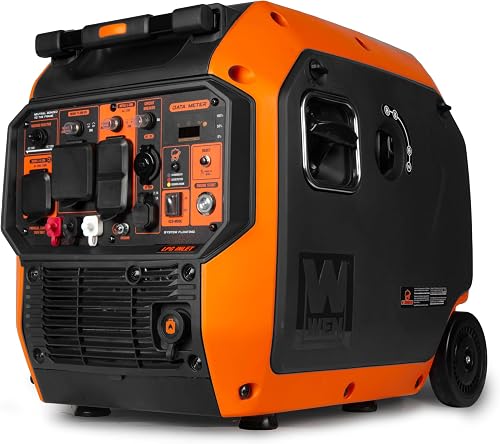
WEN 6800W Dual Fuel RV Inverter (DF680iX): Best for inverter power with 240V
- 5100 rated watts on gasoline
- 4500 rated watts on propane
- 120/240V L14-30R outlet
- CO Watchdog shutdown
The inverter design pairs with a 120/240V outlet and dual-fuel operation. Its rated output is lower on propane, so size your intended loads around that figure.
Pros
- Inverter design
- Gasoline and propane ratings are stated
- CO Watchdog shutdown
Cons
- Lower rated output than the larger open-frame options
- Confirm the outlet and connection plan with an electrician
The WEN 6800W Dual Fuel RV Inverter (DF680iX) provides 5100 rated watts on gasoline and 4500 on propane. Its L14-30R receptacle provides 120/240V output, and it also has an RV outlet.
WEN's Watchdog CO Shutdown Sensor turns the generator off if it detects dangerous carbon monoxide levels. This model includes electric start, fuel shutoff, wheels and a telescoping handle.
Choose this inverter when you want the lower output class, dual-fuel operation and an inverter design for a plan that includes electronics. Skip it if your appliance worksheet exceeds its rating, especially on propane, or if your home connection does not match its outlet.
Westinghouse 9500W Dual Fuel Home Backup: Best for remote electric start
- 7500 rated watts on gasoline
- 6750 rated watts on propane
- 30A transfer-switch-ready outlet
- Remote key fob
Remote start and a 30A home-ready outlet suit buyers who want a larger dual-fuel unit without stepping up to the highest output in this group.
Pros
- Remote electric start
- Gasoline and propane output figures
- CO shutdown
Cons
- Less output than the 12500W pick
- A home connection still needs suitable transfer equipment
The Westinghouse 9500W Dual Fuel Home Backup provides 7500 rated watts on gasoline and 6750 on propane. Its 30A transfer-switch-ready outlet makes it a middle option between the 6500W class and the higher-output 12500W model.
A remote key fob and electric start make starting convenient. The panel includes two GFCI household outlets, and the generator has automatic carbon monoxide shutdown.
The gasoline tank holds 6.6 gallons, with up to 11 hours of runtime stated by Westinghouse. Choose it when your load plan needs more running output than the 6500W pick but not the top model's capacity; skip it if you need a 50A connection.
Westinghouse 8200W Tri-Fuel Inverter: Best for three fuel choices
- 6600 running watts on gasoline
- 5940 running watts on propane and 5280 on natural gas
- 120/240V 14–50R 50A outlet
- Less than 3% THD
This inverter offers three fuel options, a 50A outlet and stated running output for each fuel. Its gasoline rating is lower than the top pick.
Pros
- Three fuel options
- 50A home-ready outlet
- Inverter design with less than 3% THD
Cons
- Output varies by fuel
- Natural gas connection planning requires qualified help
The Westinghouse 8200W Tri-Fuel Inverter provides 6600 running watts on gasoline, 5940 on propane and 5280 on natural gas. Its 50A outlet and inverter design suit a home plan where flexible fuel choices and that connection both matter.
It also has an RV outlet and a GFCI household outlet. Westinghouse states less than 3% total harmonic distortion and up to 17 hours of runtime at 25% load on a 3.9-gallon gasoline tank.
Choose it if you want an inverter with three fuel options and the lower fuel-specific ratings still cover your loads. Skip it if you expect to use natural gas without a qualified connection plan, or need more gasoline output than its rating provides.
WEN 8000W Dual Fuel: Best for CO-monitored backup
- 6500 rated watts on gasoline
- 5850 rated watts on propane
- 120/240V L14-30R 30A outlet
- CO Watchdog shutdown
The WEN gives you a 30A outlet, dual-fuel ratings and CO shutdown in a 6500-rated-watt gasoline class. Check the actual fuel configuration before planning loads.
Pros
- Gasoline and propane ratings
- CO Watchdog shutdown
- Electric start
Cons
- Lower output on propane
- 30A outlet limits the connection options
The WEN 8000W Dual Fuel provides 6500 rated watts on gasoline and 5850 on propane. It has a 120/240V 30A transfer-switch-ready outlet, an RV outlet and four household outlets.
WEN's Watchdog CO Shutdown Sensor turns the generator off if it detects dangerous carbon monoxide levels. The model has electric start, a wheel kit and a 6.7-gallon gasoline tank.
WEN states up to 10.5 hours of runtime at half load. This is a fit for a 30A connection plan with a load below its fuel-specific rating; skip it if your worksheet needs a 50A connection or more capacity.
DuroMax XP5500HX 5500W Dual Fuel: Best for lower-output plans
- 5500 watts stated output
- Gasoline or propane
- 120/240V 30A twist-lock outlet
- CO Alert
This dual-fuel option fits a smaller output class and includes a 30A twist-lock outlet. DuroMax calls its carbon monoxide feature CO Alert.
Pros
- Gasoline or propane
- 30A twist-lock outlet
- Electric start
Cons
- Less output than the larger home-backup picks
- The 5500W figure does not identify running watts
The DuroMax XP5500HX 5500W Dual Fuel has a 120/240V 30A twist-lock outlet and runs on gasoline or propane. DuroMax calls its carbon monoxide feature CO Alert.
It has electric start, two 120V GFCI household outlets and a 210cc engine. The stated 5500-watt figure does not identify running watts, so verify the continuous rating before including it in a home load plan.
Choose this option only if its confirmed running output covers a modest set of essentials and you want fuel flexibility. Skip it if you need to compare by a clearly stated continuous output and cannot confirm that figure before purchase.
Westinghouse 6600W Gas Home Backup: Best for gasoline-only backup
- 5300 running watts
- Gasoline fuel
- 30A transfer-switch-ready outlet
- Remote key fob
Choose this if gasoline is your preferred fuel and 5300 running watts covers your planned loads. It has a 30A home-ready outlet and remote start.
Pros
- 5300 running watts
- 30A home-ready outlet
- Remote electric start
Cons
- Gasoline only
- Lower output than larger options
The Westinghouse 6600W Gas Home Backup provides 5300 running watts from gasoline. Its 30A transfer-switch-ready outlet and remote key fob suit a buyer who wants gasoline operation without dual-fuel planning.
Its 4.7-gallon tank provides up to 14.5 hours of runtime. It also has an RV-ready outlet, fuel gauge and automatic carbon monoxide shutdown.
Choose it if gasoline suits your fuel plan and the 30A connection matches your home setup. Skip it if propane backup is important or your loads need more than its running rating.
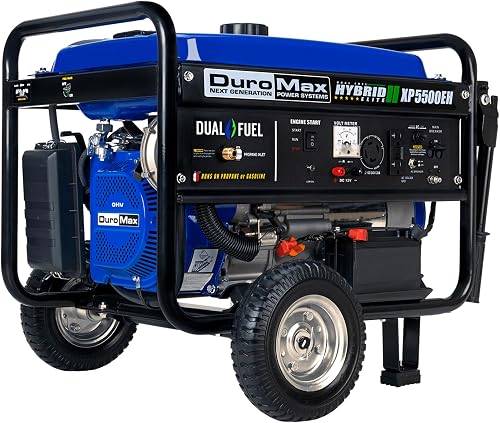
DuroMax XP5500EH 5500W Dual Fuel: Best for basic dual-fuel flexibility
- 4500 running watts
- 5500 starting watts
- Gasoline or propane
- 120/240V 30A twist-lock outlet
Its 4500 running watts and dual-fuel design suit a smaller essential-load plan. The 5500W starting figure is not the amount available for continuous use.
Pros
- Running and starting watts are specified
- Gasoline or propane
- 30A twist-lock outlet
Cons
- Lowest stated running output in this group
- The product facts do not specify a CO sensor
The DuroMax XP5500EH 5500W Dual Fuel is rated for 4500 running watts and 5500 starting watts. It runs on gasoline or propane and has a 120/240V 30A twist-lock outlet.
The control panel includes two 120V household GFCI outlets, a voltmeter and 12V DC charging posts. DuroMax describes MX2 technology for using full power at 120V when selected.
Choose it for a compact essential-load plan that stays within 4500 running watts on either fuel. Skip it when your simultaneous loads or motor start demands need more capacity, or when you require a listed carbon monoxide sensor.
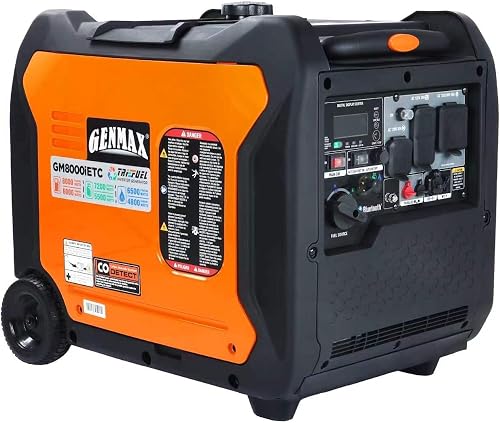
Genmax 8000W Tri-Fuel Inverter: Best for remote fuel flexibility
- 6000 running watts on gasoline
- 5500 on propane and 4800 on natural gas
- 120/240V 14–50R 50A outlet
- Bluetooth app and 2-wire auto start
The Genmax combines three fuel options with app control, auto start and a 50A outlet. Compare its fuel-specific running watts with your required loads before choosing it.
Pros
- Three fuel choices
- 50A outlet
- App and 2-wire auto-start options
Cons
- Output changes by fuel
- Auto-start setup requires a compatible plan
The Genmax 8000W Tri-Fuel Inverter has a 50A outlet and three fuel choices. It provides 6000 running watts on gasoline, 5500 on propane and 4800 on natural gas.
Its features include electric and remote start, Bluetooth app control, recoil backup and 2-wire auto-start. The control center displays running hours, load, fuel level and other operating details.
Choose this model if you value multiple fuel options and remote or auto-start features, and your loads fit the rating for the fuel you plan to use. Skip it if you need a simpler setup or cannot arrange a compatible 2-wire auto-start and home connection.
How to choose a portable generator for a house
Choose a portable generator for a house by matching its fuel-specific running watts and outlet to a written list of the loads you need during an outage. Then check where it can run safely, how you will connect it and how you will keep fuel available.
Start with priorities. A refrigerator, sump pump, well pump, furnace blower, lights, phone charging and a few outlets may matter more than trying to power every appliance at once.
Write down the running watts for each priority item and mark any motor or compressor that needs extra starting power. Add the items you expect to use at the same time, then compare the total with the generator's running rating on your selected fuel.
Starting watts are temporary and apply only when an appliance starts. If multiple motors might start together, plan for the combined starting demand or stagger their use where practical.
The generator's outlet is part of the decision. A transfer-switch-ready 30A or 50A outlet can support a home connection plan, but it must match the transfer equipment and circuits installed by a qualified electrician.
For a deeper load worksheet, use our guide to how many watts a house needs. The guide to starting watts versus running watts explains how to account for brief motor startup demands.
Which generator size suits your backup plan?
A smaller generator suits a short list of essentials, while a higher-output model gives you more room to run several larger loads together. The right size comes from your actual appliances, not the square footage of your house.
A 4500 to 5300 running-watt plan may fit a limited set of essentials if the starting demands stay within capacity. Several picks here fall in that range, with some ratings varying by fuel.
Around 6500 to 7500 running watts gives more headroom for a broader selection of circuits, but it still does not guarantee that every appliance can run at once. The 9500-watt gasoline rating of the top pick is the highest continuous output among these products.
Do not size by peak or starting watts alone. If your plan includes a refrigerator, pump and air conditioner, check each unit's running and starting needs and ask an electrician which circuits can be connected together.
For appliance-specific estimates, see what size generator can run a refrigerator and our guide to what size generator a sump pump needs.
Should you choose gasoline, propane or natural gas?
Choose a fuel based on the generator's available ratings and the fuel you can store or access safely. Dual-fuel and tri-fuel models add options, but their running output can change from one fuel to another.
Gasoline is familiar and all the gasoline ratings in this group are stated, but outage plans must account for safe storage and refueling. Propane can be useful if you already keep suitable cylinders, though its rating is lower than gasoline on the dual-fuel picks.
Natural gas is available on two tri-fuel models here. That option depends on a compatible supply and connection, so have a qualified professional confirm the installation and follow the generator's instructions.
Compare the rating for the fuel you expect to use most often, not just the highest number in the product name. For the tradeoffs in storage and fuel handling, read our propane versus gas generator guide.
Does a 30A or 50A outlet matter for home backup?
The outlet matters because it must match the transfer equipment and connection plan for your home. A larger outlet does not increase the generator's rated wattage.
A 30A connection may fit a selected-circuit setup, while a 50A connection can serve a different planned arrangement. Which is appropriate depends on your panel, generator output, transfer equipment and intended loads.
Have a licensed electrician review the full setup before buying. Never connect a generator to household wiring through a wall outlet, since that can put people and utility workers at risk.
Read our portable generator versus standby generator guide if you are deciding between a movable unit and a permanently installed system. For cord-based connections to individual appliances, use the guide to choosing a generator extension cord.
How should you set up and care for a home generator?
Set up a portable generator before an outage by learning its controls, checking the manual, planning a safe outdoor location and arranging any home connection in advance. A ready plan reduces rushed decisions when power is already out.
On first setup, complete the assembly and maintenance steps in the manual, including adding the specified oil if required. Check the supplied parts, identify the starting method and learn how to read the fuel gauge or operating display before relying on the unit.
Store the generator where it stays dry and accessible, but only operate it outdoors with the manual's required clearances. Keep cords away from walkways and use cords suited to the connected load; have a professional install transfer equipment.
Follow the manual's service intervals for oil, filters and other maintenance. The hour meter on some models can help track use, while fuel shutoff on the WEN inverter helps clear remaining fuel from the carburetor before shutdown.
Fuel storage and shutdown steps differ by model and fuel. Use approved containers and the manufacturer's directions, and keep enough fuel for the outage duration you expect rather than assuming a maximum runtime will hold at every load.
What mistakes should you avoid with a portable generator for house backup?
The most common mistake is buying by peak watts or headline wattage without checking running watts for the chosen fuel. That can leave a generator short of capacity during the outage.
Another mistake is assuming that a transfer-switch-ready outlet means the generator can connect directly to any home's panel. Outlet type, voltage, wiring and transfer equipment all need to match and should be reviewed by an electrician.
Don't place a generator in a garage, basement, porch or other enclosed or partly enclosed area. Keep it outdoors away from openings, and follow the placement distances in its manual even when the unit has a carbon monoxide sensor.
Finally, don't plan around running every appliance at once unless the load calculation supports that use. Decide which loads matter most, identify what can be switched off, and practice a safe sequence for bringing appliances online.
Where should a portable generator sit during an outage?
A portable generator must run outdoors, far from doors, windows and vents, following the placement distances in its manual. Carbon monoxide is odorless and can be deadly, so never operate one inside a home, garage or enclosed area.
Keep the generator dry and protect it from rain only in a way the manufacturer permits. Follow the manual for grounding, fuel handling and operation, and keep exhaust away from openings that could draw it indoors.
See our guide on how far a generator should be from the house before deciding where to store and run it. A CO shutdown feature is an added safeguard, not permission to use a generator indoors.
Which portable generator for a house should you choose?
Choose the Westinghouse 12500W Dual Fuel Home Backup if your load plan needs its high running output and 50A outlet. Pick the Westinghouse 6500W Dual Fuel or WEN 8000W Dual Fuel when a 30A setup and their fuel-specific ratings cover your essential circuits.
Choose the Westinghouse 8200W Tri-Fuel Inverter or Genmax 8000W Tri-Fuel Inverter if three fuel options are central to your plan and their output fits your loads. The WEN 6800W inverter is a lower-output option when inverter design and dual-fuel operation matter more than maximum capacity.
Before buying, compare running watts on your chosen fuel, motor starting needs, connection type and safe placement. Then use our portable generators for home use guide to review the rest of your backup plan.
Our top 3 picks at a glance
-
1
Best for larger backup loads
Westinghouse 12500W Dual Fuel Home Backup
9.0/10 our score
See it on Amazon -
2
Best for essential household circuits
Westinghouse 6500W Dual Fuel Home Backup
8.5/10 our score
See it on Amazon -
3
Best for inverter power with 240V
WEN 6800W Dual Fuel RV Inverter (DF680iX)
8.5/10 our score
See it on Amazon
Frequently asked questions
How many watts does a portable generator need to run a house?
There is no single wattage that runs every house. Add the running watts of the appliances you want at the same time, then account for the highest starting load, such as a pump or motor.
Compare that total with the generator's running watts for the fuel you plan to use.
Starting watts are temporary.
Can a portable generator power a whole house?
A portable generator can power selected home circuits or appliances when its output and connection equipment are suitable. A whole-house plan depends on the home's load, generator capacity and properly installed transfer equipment.
Ask a licensed electrician to assess the connection and circuits before buying.
Is a 30A or 50A generator outlet better for a house?
The right outlet depends on the transfer equipment and loads your electrician plans to connect. A 50A outlet can support a different connection setup than a 30A outlet, but it does not make a generator produce more watts.
Match the outlet, voltage and generator output to the home's approved connection.
Can I run a generator on propane during an outage?
Yes, if the generator is designed for propane and you have the correct connection and enough fuel. Check its propane running-watt rating, since it may be lower than the gasoline rating.
Store and handle fuel according to the generator manual and local requirements.
Where should I place a portable generator?
Run a portable generator outdoors, far from doors, windows and vents, and follow the placement distances in its manual. Never run it in a home, garage or other enclosed space.
A carbon monoxide sensor does not make indoor operation safe.


